
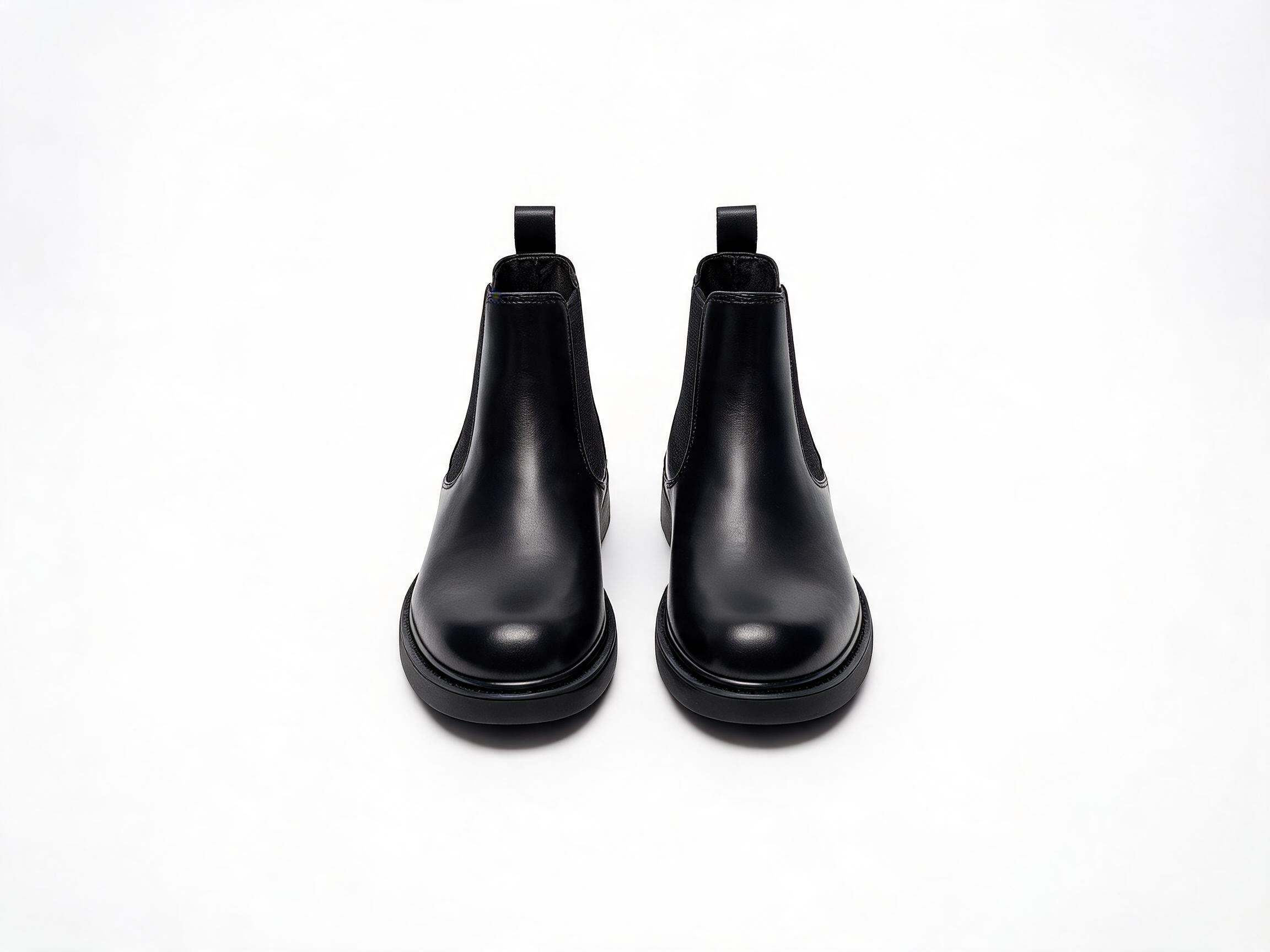
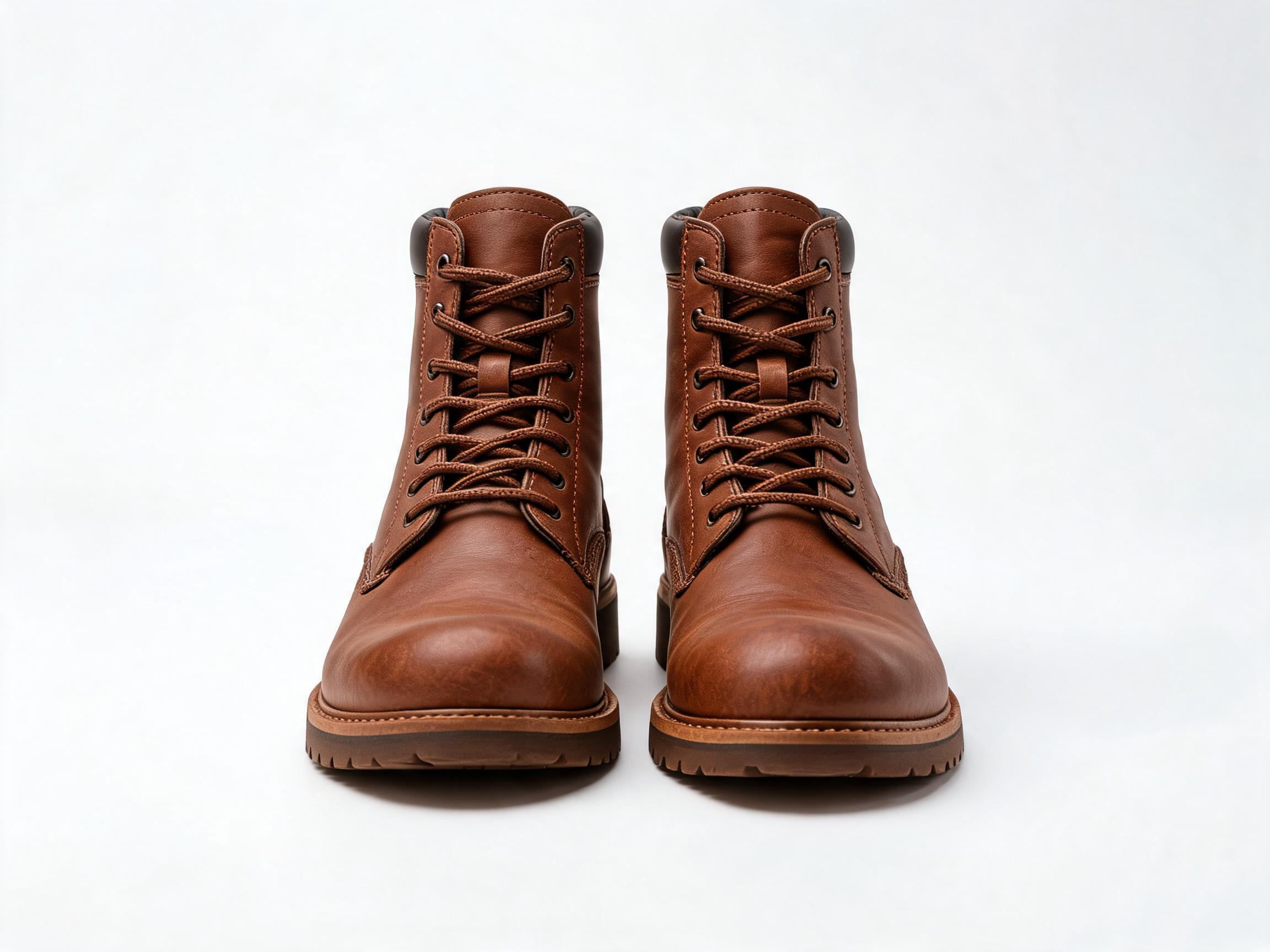
A sourcing guide for wholesale buyers covering upper leather selection (full-grain vs. oiled full-grain), cemented vs. stitched-plus-cemented construction, MOQ structures, size runs, and sample approval—illustrated with two published men's boot styles: a black Chelsea boot and a brown oiled work boot.
Wholesale Sourcing Guide
When you buy men's boots wholesale, three decisions shape the order: the upper material, the construction method, and the MOQ and size plan. This guide walks through each, using two published men's styles as practical references—a black full-grain Chelsea boot and a brown oiled full-grain work boot. Both are available for OEM/ODM programs, including color, outsole material, insole logo, and private-label box and hangtag.
Key takeaways
- Material: Full-grain leather for dress-casual Chelsea boots; oiled full-grain leather where water and oil resistance matter.
- Construction: Cemented construction suits clean fashion lines; stitched-plus-cemented construction adds a mechanical bond for heavier use.
- MOQ: The spec sheet lists 100 pairs per color for the Chelsea and 200 pairs per color for the work boot, with 30–40 and 35–45 day lead times after confirmation.
- Size runs: Chelsea EU 39–45; work boot EU 39–46.
- Samples: Stock samples in 3–5 days; custom samples about 7–12 days.
What this guide covers
1. Upper materials: full-grain vs. oiled full-grain
Full-grain leather retains the outer surface of the hide, so the grain pattern is natural and the material takes a finish without a split or corrected surface. In a Chelsea boot, the result is a clean, uniform upper that holds shape and polish. Our black men's Chelsea boot uses full-grain leather with dual side elastic gussets—a construction that avoids laces and keeps the silhouette close to the ankle. The boot stands about 15 cm high with a heel of about 3 cm.
Oiled full-grain leather starts from the same grain layer but is treated with oils and waxes that penetrate the hide. This makes the surface more resistant to water and to staining from oils and fuels, which is why it appears in work and outdoor footwear. The brown oiled full-grain work boot uses this upper, adds a reinforced toe, and sits on an oil-resistant, slip-resistant lug rubber outsole as specified in the listing (confirm the test method and applicable standard in the RFQ). It also has a cushioned, fatigue-resistant insole. Like the Chelsea, it stands about 15 cm high.
Knit uppers are a different category. A knit boot is lighter and more breathable, but it does not offer the abrasion resistance or structure of leather, and it is generally not the first choice for a workwear or outdoor line where the boot must hold its shape under load. For a wholesale program that includes both fashion and functional boots, the split is usually: full-grain leather for the fashion and dress-casual end, oiled full-grain for the utility end, and knit only as a distinct lightweight style.
Quick comparison of the two published styles
| Feature | Black Chelsea boot | Brown work boot |
|---|---|---|
| Upper | Full-grain leather | Oiled full-grain leather |
| Construction / key build details | Stitched rubber outsole; dual elastic side gussets | Reinforced toe; bonding method not stated in the listing — confirm in the RFQ |
| Outsole | Rubber | Oil-resistant, slip-resistant lug rubber |
| Insole | — | Cushioned, fatigue-resistant |
| Height / heel | About 15 cm / 3 cm | About 15 cm |
| Size range | EU 39–45 | EU 39–46 |
| MOQ (spec sheet) | 100 pairs per color | 200 pairs per color |
| Lead time after confirmation | 30–40 days | 35–45 days |
2. Construction: cemented vs. stitched plus cemented
Two construction methods matter for men's boots at wholesale volume. Cemented construction bonds the upper to the outsole with adhesive under pressure. It is common in fashion and casual boots because it allows a lighter, more flexible sole and a cleaner side profile. A stitched-plus-cemented construction adds a stitched connection—typically through the outsole or a welt—on top of the adhesive bond.
The black Chelsea boot is listed with a stitched rubber outsole and dual elastic side gussets. The listing does not state whether adhesive bonding is also used, so if double fixation matters to your program, confirm the full construction with the sales team before you set the specification. For a work boot, the combination matters more: adhesive alone can fail under repeated flexing and oil exposure, so a stitched plus cemented build is the safer specification for a boot that will be worn in wet, oily, or uneven conditions. Note that the brown work boot's listing specifies the oiled full-grain upper, the reinforced toe and the lug outsole, but does not state the bonding method — treat stitched-plus-cemented as a requirement to state in the RFQ and verify on the sample, not as an assumed default for this model.
Our production inspection is three-stage and includes a forefoot flex test and an outsole adhesion check. Those checks are part of the process we run; they are not a guarantee of a specific service life, which depends on wear conditions and on the materials as specified. If your program has a defined flex or adhesion target, state it in the RFQ so the sample can be checked against it.
3. MOQs and order planning
MOQ in men's boots is usually quoted per color, not per style or per size. The spec sheet for the two published styles lists 100 pairs per color for the black Chelsea and 200 pairs per color for the brown work boot. Lead time after confirmation is 30–40 days for the Chelsea and 35–45 days for the work boot. Confirm current MOQ and lead time with the sales team before ordering, because both can shift with material availability and customization.
A practical order plan separates three quantities:
- Total order quantity—what you commit to across all colors and sizes.
- Per-color quantity—must meet the per-color MOQ; a two-color order therefore needs at least 200 pairs for the Chelsea (100 + 100) and 400 pairs for the work boot (200 + 200).
- Size breakdown—the size curve you want per color, which must fit the size range offered (EU 39–45 for the Chelsea, EU 39–46 for the work boot).
If you are testing a new style, the smaller per-color MOQ of the Chelsea makes it the lower-risk test. The work boot’s higher per-color MOQ reflects a more specialized upper and outsole, so it is usually planned after the style has been validated.
4. Size runs and sample approval
Both styles cover a men’s size range that starts at EU 39. The Chelsea runs to EU 45; the work boot to EU 46. When you build a size curve, check that your planned ratios fall inside those ranges. A size outside the range is a development question, not a standard order.
Samples are the step where material and construction decisions become physical. Stock samples ship in 3–5 days. Custom samples—where you change color, outsole material, insole logo, or packaging—take about 7–12 days. Approve the sample for fit, upper color and finish, outsole hardness and lug pattern, insole branding, and packaging before releasing bulk. The sample is also the reference for the three-stage inspection; if the factory’s inspection includes a forefoot flex and an outsole adhesion check, confirm that the same checks apply to your production run.
5. OEM/ODM options
Both styles are available for OEM/ODM. The customization list includes upper color, outsole material, insole logo, and private-label shoe box and hangtag. For a retail chain or a workwear brand, the key planning question is which changes affect MOQ and lead time. A color change is usually the least disruptive; an outsole material change may require a new mold or a different stock sole, which can move both MOQ and timing. Confirm those effects with the sales team before you finalize the purchase order.
Both styles are exported to Europe, North America, and the Middle East. If your market has specific labeling or packaging requirements, include them in the sample request so they can be checked at the sample stage rather than after bulk production.
6. FAQ
What is the MOQ for these men's boots?
The spec sheet lists 100 pairs per color for the black Chelsea boot and 200 pairs per color for the brown work boot. Confirm current MOQ and lead time with the sales team before ordering.
Can I order multiple colors in one style?
Yes, but each color must meet its own per-color MOQ. For example, two colors of the Chelsea require at least 200 pairs total.
How long does sampling take?
Stock samples take 3–5 days. Custom samples, including color or logo changes, take about 7–12 days.
What is the difference between the two boots’ constructions?
The Chelsea uses a stitched rubber outsole with elastic side gussets. The work boot uses oiled full-grain leather with a reinforced toe, an oil-resistant and slip-resistant lug rubber outsole, and a cushioned, fatigue-resistant insole; its bonding method is not stated in the listing, so confirm it in the RFQ.
Can I customize the outsole or insole?
OEM/ODM options include outsole material, insole logo, upper color, and private-label packaging. Because outsole changes can affect MOQ and lead time, confirm the details with the sales team before ordering.
What size ranges are available?
The Chelsea boot runs EU 39–45; the work boot runs EU 39–46.