
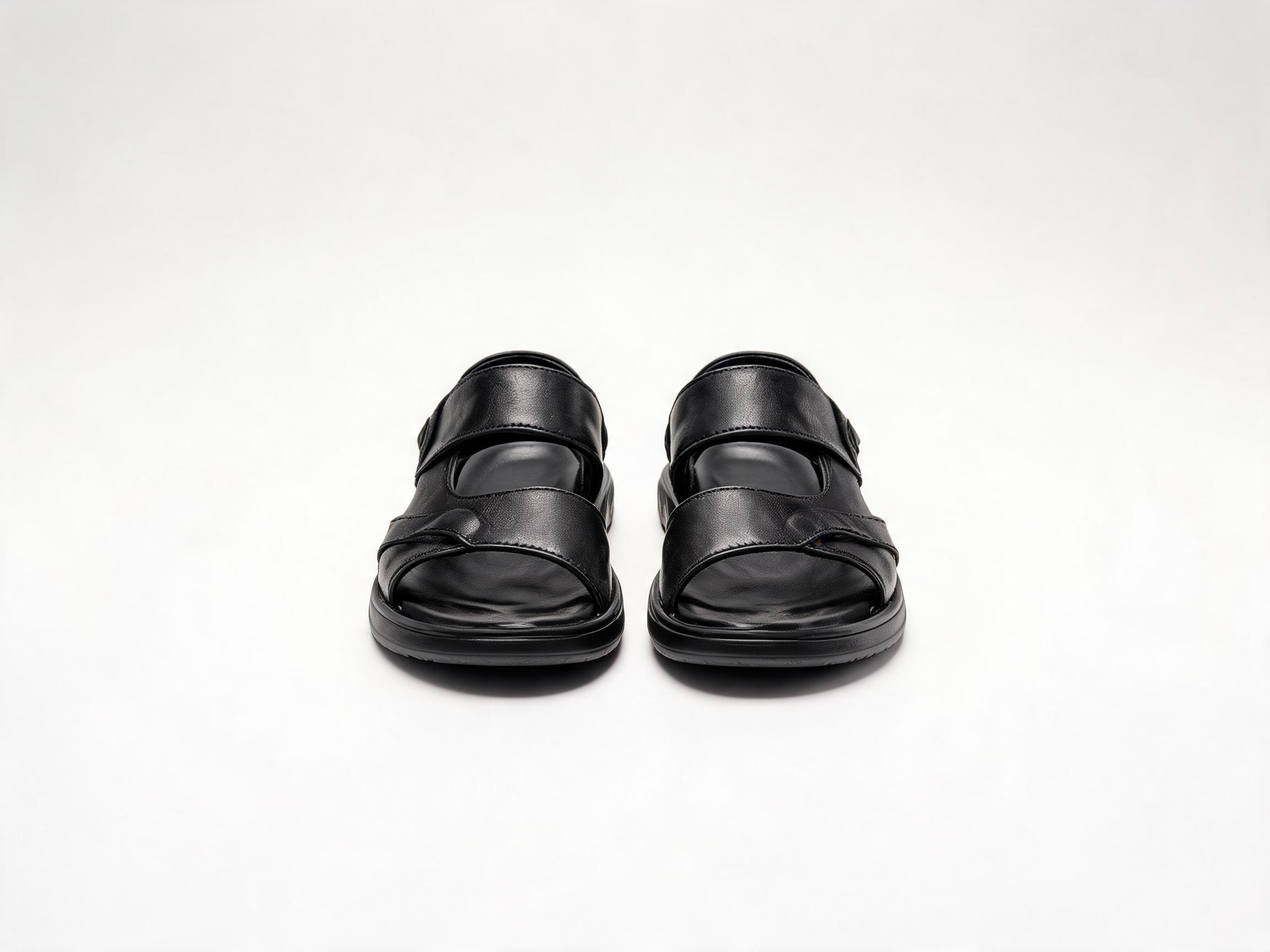
A buyer's program guide to private label sandals: how to choose base constructions, plan brand touchpoints and colorways, run sampling from a reference or tech pack, and apply sandal-specific QC checks before your first branded summer range goes to production.
Private label sandals let an own-brand team put its name on a product that already exists in a factory's line — but only if the program is structured before the first sample is cut. This guide walks through the decisions that matter: construction, brand touchpoints, colorway planning, sampling, and the sandal-specific QC checks that decide whether a summer range holds together on the shelf.
What this guide covers
- What a private-label sandal program actually includes, and where it differs from a stock buy.
- How to pick base constructions for a first range.
- Which brand touchpoints a factory can realistically customize.
- How to plan colorways and size runs without overcommitting.
- The sampling workflow from a reference shoe or a tech pack.
- Sandal QC points — strap strength, buckle corrosion, sole adhesion.
What private label means for a sandal program
In a private-label arrangement, the buyer owns the brand and the commercial positioning; the factory owns the manufacturing. You are not buying a finished catalogue SKU with a logo stamped on it. You are selecting a base construction, then specifying the brand-relevant elements — leather or upper material, buckle hardware, footbed treatment, packaging — and having that combined build produced under your label.
Aurevia Footwear Co., Ltd. is a B2B footwear manufacturer and exporter founded in 2011 in Quanzhou, China, with roughly 260 staff and OEM/ODM and private-label programs serving buyers mainly in Europe, North America and the Middle East. Trade terms are EXW, FOB or CIF, and quality control runs in three stages: incoming material, in-line, and final finished-shoe inspection. Third-party inspection is welcome, and there is a six-month quality warranty on manufacturing defects. You can review the company background on the About Us page, and request quotations or a sampling plan through the Contact page.
The practical consequence for a buyer: a sandal program is a specification exercise first and a purchase order second. Everything you want to be different from the factory's base shoe should be written down before sampling starts.
Choosing base constructions for a first range
Resist the urge to launch six silhouettes. A first summer range works best with one or two constructions, proven in sampling, then extended through color and material rather than through new lasts.
A useful starting point is a men's open-toe casual sandal, since it covers a wide retail window. The published Black Leather Casual Sandals reference from Aurevia shows what a well-documented base looks like: smooth black calf leather, adjustable buckle straps across the instep and ankle, a cushioned leather footbed with an arch-support contour, stitched-and-cemented construction, a lightweight rubber anti-slip outsole, and EU sizes 39–45. You can review the specification on the Black Leather Casual Sandals product page as a template for how much detail a base should carry.
Three construction questions shape the rest of the program:
- Upper material: leather, synthetic, or a mix. Leather tolerates color matching to a Pantone reference; synthetics often need a different approval route.
- Sole attachment: stitched-and-cemented construction gives you a defined bond line to inspect; other methods change where your QC attention goes.
- Closure system: buckle straps are the most brand-visible option because the hardware is customizable, but they also introduce a corrosion check.
Brand touchpoints a factory can customize
Branding on sandals lives in small places. Buyers often assume a logo on the box is enough; in practice the footbed and hardware do more work at the point of try-on.
| Touchpoint | What it involves | Buyer decision |
|---|---|---|
| Footbed branding | Logo or wordmark applied to the footbed surface, in the arch or heel area | Application method, contrast against footbed color, wear expectations |
| Buckle hardware | Change of buckle shape, finish or metal; corrosion testing method and report confirmed with the supplier | Finish (e.g. brushed vs polished), size relative to strap width |
| Leather color | Color matching to a Pantone reference | Reference number, acceptable tolerance, approval under daylight |
| Boxes | Private-label boxes printed to your artwork | Board grade, print method, size relative to the sandal |
| Hangtags | Branded hangtags attached at packing | Material, string type, barcode and size labeling placement |
One detail worth specifying in writing: straps cut from matched hides so left and right share grain direction and shade. It is the kind of point that separates a consistent pair from a mismatched one, and it belongs in the spec, not in a verbal instruction.
Colorway and size planning
Color planning for a summer range is a forecasting exercise as much as a design one. Black, brown and tan are the standard core for leather sandals and are the lowest-risk anchors; custom colors extend the range but add an approval step and complicate reorders.
A workable structure for a first season:
- Core colors in the full size run, ordered deepest.
- One or two fashion colors in the middle sizes only, to test demand without holding dead stock at the extremes.
- Custom color held back for a second drop, once you have seen sell-through.
On sizing, EU 39–45 is a common men's range for this construction. Confirm with the factory which size grading the base last uses and whether your target market needs a half-size or a wider fit — small grading differences are expensive to fix after production.
Order minimums and production windows are usually structured per color, material and construction rather than as one line-wide figure. To control first-order risk, keep core colors in the full size run and hold test colors to the middle sizes; work the production window backward from your launch date and leave buffer for sampling and approval. Ask the supplier to state the minimums and lead time for your exact colorways in the written quotation, and confirm both before you commit to a purchase order.
Sampling workflow from a reference shoe or tech pack
There are two ways into sampling. If you have a physical reference sandal, the factory reverse-engineers the construction and you approve against the shoe in hand. If you have a tech pack, the factory builds to your drawing and specification, and you approve against the document.
Either route follows the same sequence:
- 1. Brief and material selection. Base construction, upper material, footbed, outsole, hardware, colorway.
- 2. Confirmation of details. Pantone references, logo artwork in vector format, box and hangtag layouts. Custom samples are typically produced in about 7–12 days after details are confirmed — production time only, with international transit additional.
- 3. Sample review. Check fit on the last, strap lengths, buckle position, footbed branding legibility, and color against the reference under daylight.
- 4. Revision round. Log every change in writing and re-approve.
- 5. Sign-off and pre-production sample. Keep the signed sample as the QC reference for the bulk run.
If you want to see a base before committing to customization, existing samples can be dispatched in about 3–5 days, with international transit additional. That is often enough to decide whether a construction suits your market before you spend time on a tech pack.
Sandal-specific QC points
Sandals fail in different places than closed shoes. Three checks deserve to be written into your inspection criteria rather than left to general visual inspection.
Strap strength
Straps take the full load of walking and are stitched or riveted at the sole edge and buckle. Inspection should confirm stitch density is consistent, that no stitch line runs off the strap edge, and that the strap-to-sole attachment on both shoes matches. Ask how strap pull is checked at final inspection.
Buckle corrosion
Buckles sit against skin, sweat and humidity. Ask the supplier to confirm how buckle hardware is tested for corrosion resistance, and request the test method and report that apply to the specific finish you chose, since plating and coating differ. A finish change late in the program should trigger a re-check.
Sole adhesion
With stitched-and-cemented construction, the bond line is visible and inspectable. Check for gaps, excess adhesive, and consistent cement spread along the full length of both shoes. Where stitching is present, confirm it penetrates as specified.
These checks fit inside a three-stage QC flow: incoming material inspection, in-line inspection, and final finished-shoe inspection. Third-party inspection is welcome if your own team or a nominated agency wants to verify the bulk run.
A short launch checklist
- Base construction selected and sample approved in writing.
- Leather color matched to Pantone reference; tolerance agreed.
- Buckle hardware finish confirmed and corrosion test method and report clarified.
- Footbed branding artwork approved at production size.
- Box and hangtag layouts approved; barcode and size labeling placement fixed.
- Size grading confirmed for your target market.
- Colorway plan split into core and test colors.
- Order minimums per color and production window confirmed with the supplier.
- QC criteria documented, including strap strength, buckle corrosion and sole adhesion.
- Signed pre-production sample retained as the bulk reference.
Frequently asked questions
Can we start a private-label sandal range without a tech pack?
Yes. A physical reference sandal is enough to begin: the factory works from the shoe, and your specification is built up through sampling rounds. A tech pack becomes more useful once you want to change proportions, materials or hardware in ways the reference cannot show.
How much of the sandal can carry our brand?
Footbed branding, buckle hardware, leather color, boxes and hangtags are all customizable in a private-label program. Decide early which of these appear on every SKU and which are reserved for hero styles.
What should we confirm before placing a bulk order?
The minimums per color and construction, the current production window measured back from your launch date, and the inspection plan. Ask for all three in the written quotation for your exact colorways rather than assuming a standard figure.
What happens if a manufacturing defect appears after delivery?
Aurevia provides a six-month quality warranty on manufacturing defects. Keep the signed pre-production sample and your approved specification on file — they are the reference for any claim.