
A concrete walkthrough for own-brand buyers: how to discuss logo application methods, packaging choices and MOQ terms with a private label sneaker OEM, using the Aurevia Footwear specification sheets as a reference point.
Own-brand OEM · Process explainer
Launching a private label sneaker line means making three decisions before the first pair is made: how your logo will appear on the shoe, what the packaging will look like, and what quantities the factory will actually run. Each decision affects the others, and all three are settled through direct conversation with the OEM supplier. This article walks through those conversations using Aurevia Footwear Co., Ltd. as a reference point — a genuine-leather footwear OEM/ODM exporter founded in 2011 with about 260 staff, serving buyers in Europe, North America and the Middle East.
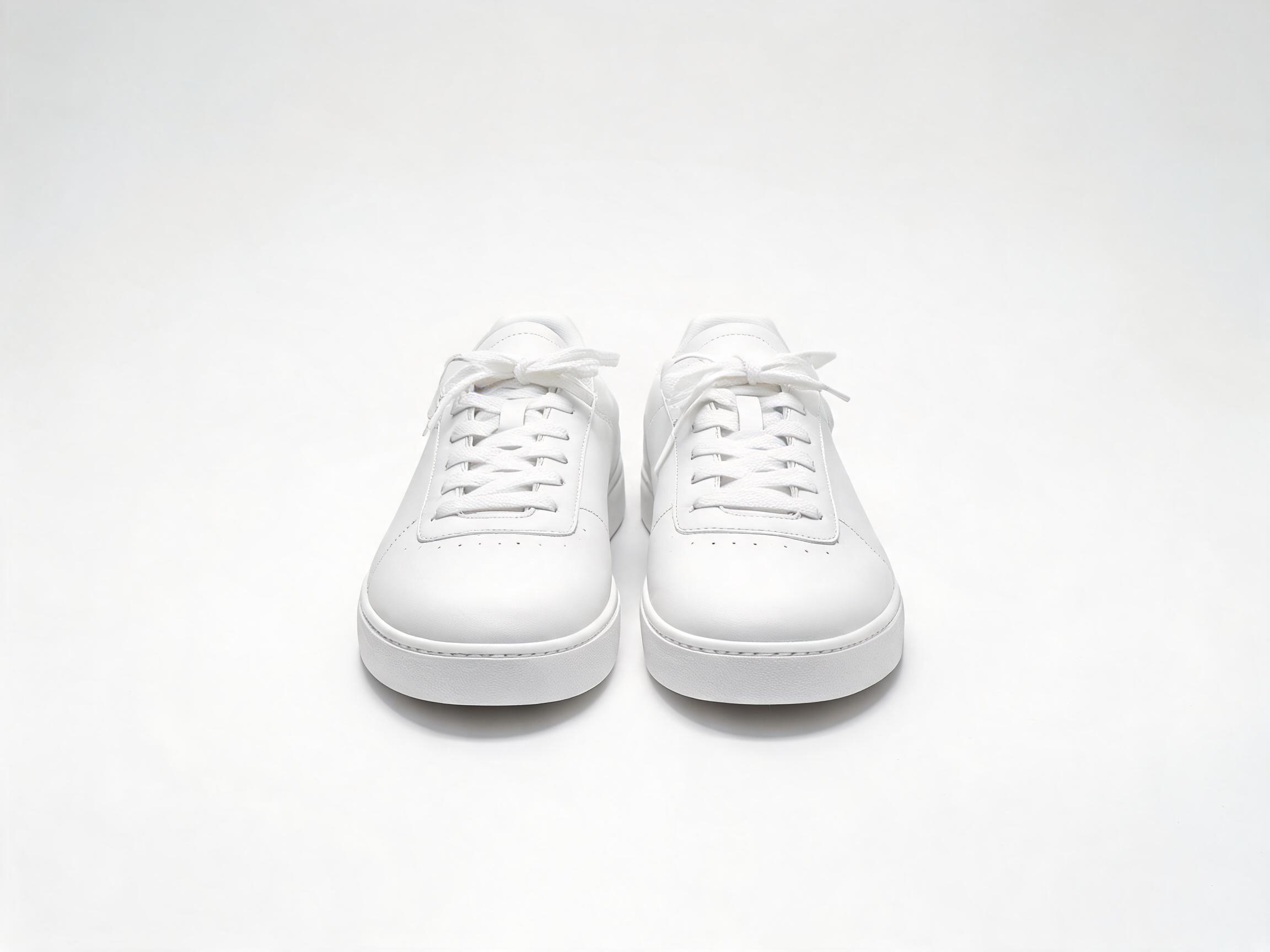
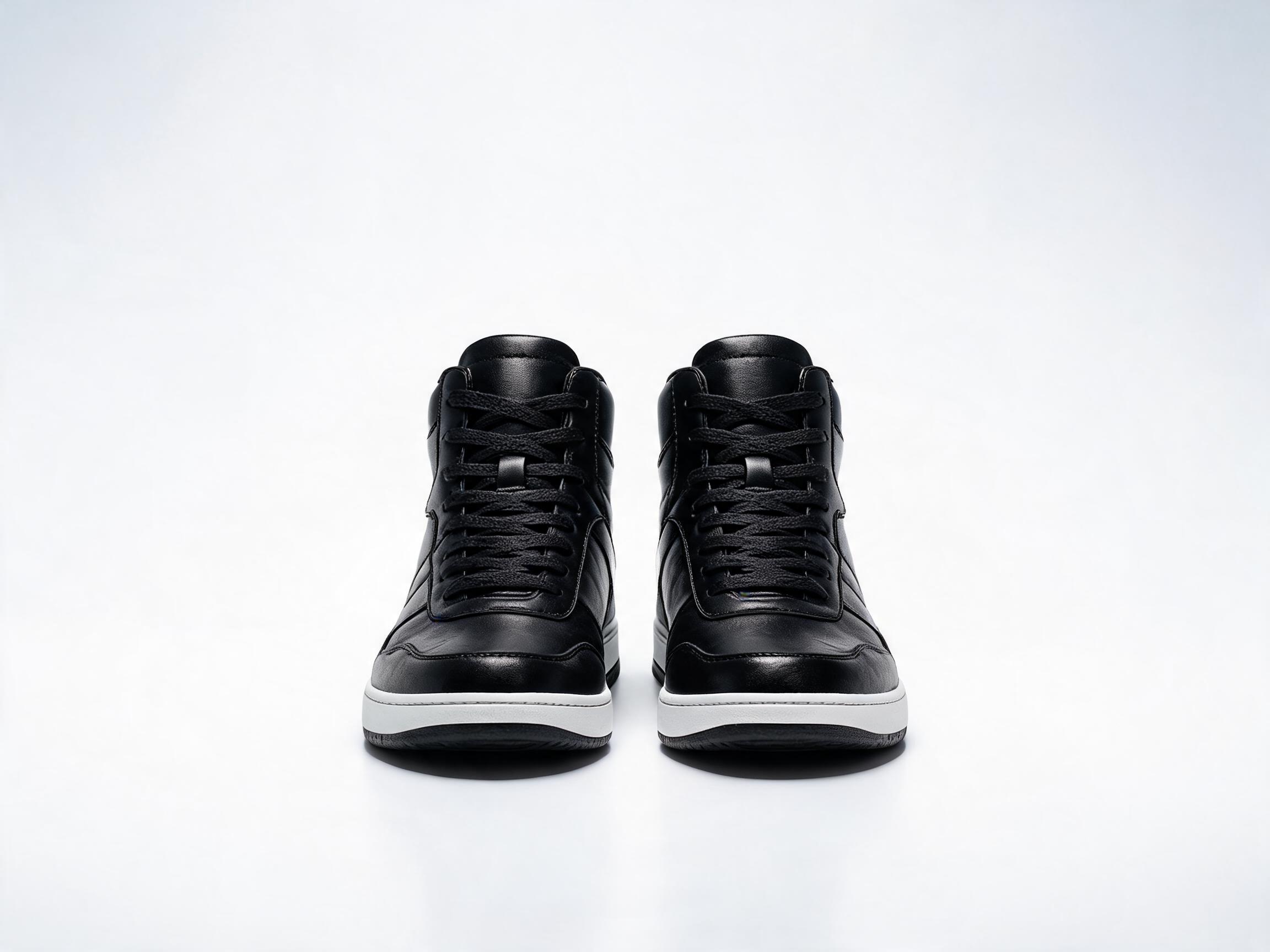
The examples below draw on three specification-sheet product listings from Aurevia: White Leather Low-Top Sneakers (full-grain leather upper, rubber cupsole, EU 39–45 / US 6.5–12, MOQ 200 pairs, lead time 30–40 days), Black Leather High-Top Sneakers (EU 39–45, MOQ 200 pairs, lead time 30–40 days) and Grey Knit Running Sneakers (engineered knit upper, EVA midsole, EU 39–45, MOQ 200 pairs, lead time 30–40 days).
Key takeaways
- Logo placement and method are discussed per style; printed, embossed, metal badge and woven label are the common options, but each must be confirmed against the actual upper material.
- Packaging (box, tissue, inserts, polybag) is a separate line item; request a sample or mock-up and confirm the exact contents before committing to a production run.
- The listed MOQ of 200 pairs and lead time of 30–40 days are specification-sheet figures — always confirm current MOQ and lead time with the sales team before ordering.
- Size ranges EU 39–45 (US 6.5–12 on the white low-top) apply to the listed styles; confirm size grading and any size-run requirements when you place the order.
In this article
Logo application: printed, embossed, metal badge, woven label
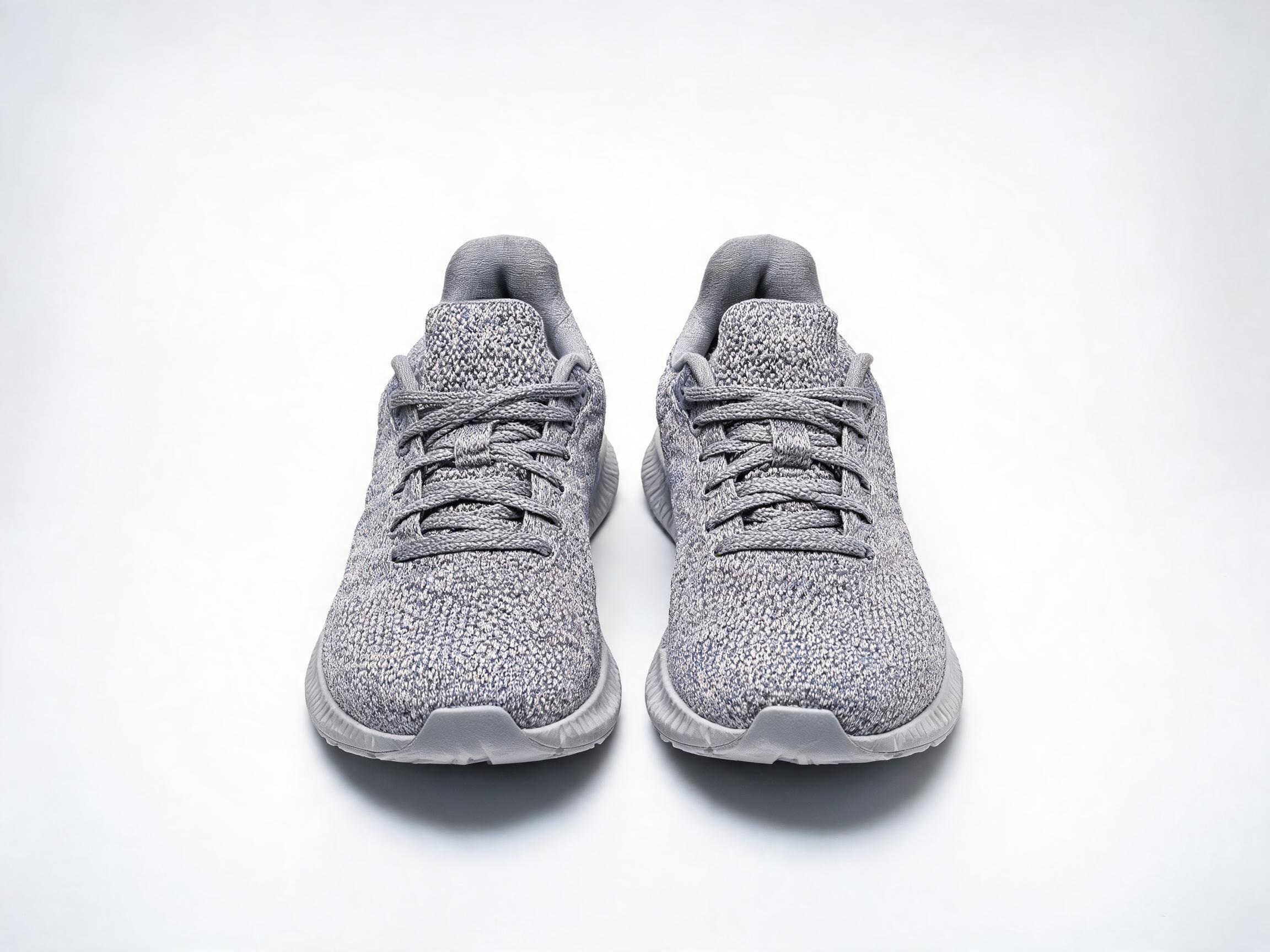
There is no single “best” logo method for a private label sneaker. The right choice depends on the upper material, the size and color of your mark, and where it sits. On the three Aurevia styles referenced above, the upper materials differ — full-grain leather on the white low-top and black high-top, engineered knit on the grey running sneaker — so the same logo method may behave differently across the range.
Printed logo
Printing is usually the first method to discuss for knit uppers, where a flat graphic can sit directly on the textile. For leather uppers, print is typically discussed for smaller marks or for logos placed on a leather patch rather than directly on the grain. When you raise print with the supplier, ask which print process they propose for the specific upper, how the mark will be positioned, and what the proposed color reference is. Bring your own color target (for example, a Pantone reference) so the supplier can confirm whether it is achievable.
Embossed logo
Embossing is a leather-focused option. On the full-grain leather upper of the White Leather Low-Top Sneakers, an embossed mark relies on the leather surface taking and holding a raised or debossed impression. The conversation here is about depth, die cost and placement: ask whether the supplier proposes embossing directly on the upper or on a separate leather patch, and confirm how the mark will be positioned across sizes so it does not distort as the pattern scales. Embossing is not a natural fit for the engineered knit upper on the running sneaker, so if you plan a logo across all three styles, expect the method to change per style.
Metal badge
A metal badge is a separate hardware component attached to the shoe, often on the heel or tongue. It adds a distinct visual element but also introduces a component to specify: the supplier will need the badge dimensions, the attachment method and the finish. Discuss where the badge sits on each style — a high-top and a low-top have different available real estate — and confirm that the proposed position does not interfere with the lacing or collar. Metal badges are typically confirmed with a mock-up before production.
Woven label
Woven labels are common on tongues, side panels and heel tabs, and work on both leather and knit uppers because the label is a separate piece stitched or attached to the shoe. The supplier will need the label dimensions, the weave colors and the placement. Ask for a physical label sample before production so you can check the mark’s legibility at final size. If the label is stitched onto the knit upper of the running sneaker, discuss how the stitching interacts with the engineered knit construction.
| Method | Typical discussion points | Style considerations |
|---|---|---|
| Printed | Process for the specific upper, mark size, color reference, placement | Often discussed for knit uppers; on leather, often as a printed patch |
| Embossed | Impression depth, die, patch vs direct, scaling across sizes | Leather-focused; not a natural fit for knit |
| Metal badge | Badge dimensions, attachment method, finish, position | Position differs between low-top and high-top |
| Woven label | Label size, weave colors, placement, stitching | Works across leather and knit uppers |
The table lists topics to discuss and confirm with the supplier; it is not a statement of the supplier’s specific capability for any method. Ask the sales team which methods they propose for each style.
Packaging decisions that affect the production brief
Packaging is often treated as an afterthought, but it changes the production brief: it affects order quantities (inner and outer cartons), the packing line, and what the buyer receives at the warehouse. For a private label sneaker launch, packaging usually breaks into four decisions:
- Primary box: shoe box style, material and print. Ask whether the supplier sources the box or whether you supply it; if the supplier sources it, confirm the box specification and artwork approval process.
- Inner wrapping: tissue paper, polybag or both. Confirm what is standard for the style and what can be changed.
- Inserts: hangtags, size stickers, care cards, desiccant. Each insert needs a specification and an approval step.
- Outer carton: carton markings, packing quantity per carton, and any barcode or label requirements for your warehouse. Confirm the carton marking layout before production.
For each of these, the useful conversation is not “what packaging do you offer?” but “for this style and this order, what packaging will you propose, and what do you need from me to quote it?” Bring your artwork files, your warehouse labeling requirements and your target packing quantity; the supplier can then confirm what is feasible and what needs to be sourced separately. Packaging is typically confirmed with a physical mock-up or a pre-production sample before the full run.
How MOQ conversations actually go
Minimum order quantity is where a private label sneaker project either becomes concrete or stalls. The specification sheets for the Aurevia styles list MOQ 200 pairs and lead time 30–40 days. Those are the specification-sheet figures — not a quote for your specific order. Before ordering, confirm current MOQ and lead time with the sales team.
Why the listed MOQ is a starting point, not a final number
An MOQ is usually tied to a specific style, size range and configuration. The listed 200 pairs for the White Leather Low-Top Sneakers, Black Leather High-Top Sneakers and Grey Knit Running Sneakers applies to those styles as listed. If your brief adds a custom logo method, custom packaging or a custom size breakdown, the MOQ conversation changes. The productive approach is to state your requirement clearly — style, logo method, packaging, size run — and ask the supplier to confirm the MOQ that applies to that exact combination.
Lead time and what affects it
The listed lead time of 30–40 days is a specification-sheet range. Lead time typically starts from a defined point — often after final sample approval and artwork sign-off — so confirm with the sales team when the clock starts, what approvals are needed, and whether packaging adds time. Again, confirm current MOQ and lead time with the sales team before ordering; do not plan a launch date around the specification-sheet figure alone.
Size runs
The listed size range for all three styles is EU 39–45, with US 6.5–12 on the white low-top. An MOQ of 200 pairs has to be distributed across sizes. When you discuss MOQ, bring your own size ratio (for example, how many pairs of each size you want) and ask the supplier to confirm that the ratio is compatible with the MOQ. This is often the point where a buyer discovers whether the order is viable as specified or needs adjustment.
| Specification-sheet item | Listed figure | Confirm before ordering |
|---|---|---|
| MOQ — White Leather Low-Top Sneakers | 200 pairs | Current MOQ with the sales team |
| MOQ — Black Leather High-Top Sneakers | 200 pairs | Current MOQ with the sales team |
| MOQ — Grey Knit Running Sneakers | 200 pairs | Current MOQ with the sales team |
| Lead time — all three styles | 30–40 days | Current lead time and start point with the sales team |
| Size range — all three styles | EU 39–45 (US 6.5–12 on white low-top) | Size grading and ratio with the sales team |
Putting logo and packaging into one brief
Logo method and packaging are not independent. A metal badge adds a component that may affect packing; a custom printed box adds an artwork approval step that may affect lead time; a woven label on the tongue may need to be approved alongside the packaging artwork. The cleanest way to run the OEM conversation is to combine all three topics into a single brief and ask the supplier to respond to the combination.
A brief that tends to produce usable answers looks like this:
- Style reference: name the product page(s) you are working from, e.g. White Leather Low-Top Sneakers.
- Logo: method(s) under consideration, placement, dimensions, color reference, and whether the method must be consistent across styles.
- Packaging: box spec or artwork, inserts, outer carton marking, packing quantity.
- Size run: your intended distribution across EU 39–45.
- Quantity: your target quantity, acknowledging the listed MOQ and asking for confirmation of the applicable MOQ.
Send it as a written document with attachments (logo files, packaging artwork, labeling spec). The reply is the proof of what the supplier can do — not the catalog page. Expect the supplier to come back with proposed methods, any constraints, and a request for missing information; that is the normal shape of the conversation, not a sign of delay.
What to ask before you commit
Before placing a private label sneaker order, you should have written answers to a short list of questions. The list below is a starting point; add any question specific to your market or channel.
- For each style, which logo methods do you propose, and what is the sample or mock-up process?
- What exactly is included in the packaging proposal, and which items do I need to supply?
- What is the current MOQ and lead time for the exact combination in my brief?
- When does lead time start, and what approvals are needed before production?
- What is the size grading, and can my intended size ratio be accommodated within the MOQ?
Conversations like these are how a private label sneaker program moves from a product listing to a production plan. Aurevia Footwear Co., Ltd., as a genuine-leather footwear OEM/ODM exporter founded in 2011 and serving Europe, North America and the Middle East, is set up for this kind of buyer dialogue — but the terms that apply to your order come from the sales team’s written confirmation, not from a catalog page. Start with the styles that fit your line, then send a combined brief covering logo, packaging and quantity.
Frequently asked questions
Can I use a different logo method on different styles?
Yes — that is a normal part of the discussion. The upper material differs across the three referenced styles (full-grain leather on the white low-top and black high-top; engineered knit on the running sneaker), so the logo method may need to change per style. Discuss the full range with the supplier in one brief so the methods are coordinated.
Is the listed MOQ of 200 pairs per style or across the order?
The specification sheets list MOQ 200 pairs per style. Whether a combined order across multiple styles affects the MOQ is a question for the sales team — confirm it in writing before you plan quantities. Always confirm current MOQ and lead time with the sales team before ordering.
Do I need to provide packaging artwork, or can the supplier design it?
That depends on the supplier’s service scope. Raise it in the packaging conversation: state what you will supply (artwork, labeling spec) and ask what the supplier proposes to source or design. Confirm the answer before production.