
A practical screening guide for importers evaluating wholesale shoe manufacturers. Learn how to verify real production capacity versus claimed capacity, check QC systems you can observe, and assess communication practices across time zones. Includes a screening checklist and sample manufacturer disclosures.
Supplier Screening Guide
When importers search for wholesale shoe manufacturers, the initial list of candidates often looks similar: polished websites, responsive sales reps, and promises of competitive pricing. The real differences emerge when you move from brochure claims to verifiable operating facts. This guide focuses on three screening areas that separate reliable manufacturing partners from those that struggle under load: actual production capacity, observable quality control systems, and communication practices that hold up across time zones.
Key takeaways
- Capacity claims should be broken down by line, product type, and current order backlog—ask for a capacity statement, not a single number.
- QC is verifiable through documentation, physical samples, and walkthrough questions about inspection stages and test methods.
- Communication reliability is a leading indicator of order execution; test response time and clarity before placing a bulk order.
- Every MOQ and lead time is a snapshot—confirm current figures with the sales team before ordering.
Contents
Verifying real capacity versus claimed capacity
A manufacturer's stated monthly output is less useful than a capacity statement that describes how that output is structured. Ask for a breakdown by production line, product category, and current utilization. For example, a factory that runs separate lines for cemented construction and injection-molded footwear will have different capacity ceilings per product type. If a supplier cannot separate capacity by product family, the single figure is likely an estimate rather than a managed number.
Three follow-up questions sharpen the picture:
- What is your current order backlog in weeks? A backlog that exceeds the quoted lead time suggests either optimistic scheduling or a capacity constraint the sales team has not disclosed.
- How many pairs per day can you complete on a dedicated line for this construction? This ties capacity to the specific product you are sourcing, not a generic total.
- Can you share a recent production schedule or line-loading snapshot? Even a redacted version shows whether the factory plans by line and delivery date.
Note that any capacity figure a supplier provides is a snapshot. MOQ and lead time should be confirmed with the sales team before ordering, because both shift with material availability, seasonal demand, and order mix.
QC systems you can verify
Quality control claims are easy to make and hard to disprove remotely. The most reliable approach is to ask for a description of the inspection stages and the test methods used at each one. A manufacturer that operates a documented three-stage inspection—incoming materials, in-line, and final—can usually explain what is checked at each gate and who signs off.
For footwear, certain physical tests are standard indicators of a functioning QC system:
- Flex testing to check sole and upper integrity under repeated bending.
- Color fastness testing for leather and textile uppers, especially where dye transfer could affect linings or socks.
- Heel-attachment testing to confirm the heel is secured to the sole assembly.
Ask whether these tests are performed in-house or by a third party, and request a sample inspection report (with commercial details redacted if necessary). A report that lists the test method and acceptance criteria tells you more than a certificate of conformity alone.
Physical samples remain the most direct verification. Request a production sample from the current run, not a specially prepared showroom sample. Compare stitching density, lining finish, and sole bonding against the specification sheet. If the factory cannot provide a production-run sample, that is a question worth raising before you commit to a bulk order.
Communication practices that predict smooth cooperation
Communication is the operating system of an import order. A supplier that responds clearly during the screening phase is more likely to handle change requests, production updates, and quality issues with the same discipline. What to observe:
- Response time: How quickly do they answer a detailed technical question? A stated 48-hour response window is a useful benchmark—test it with a question that requires checking with production.
- Clarity of answers: Do they answer the specific question, or reply with a generic capability statement? Specific answers—listing materials, machine types, or test standards—indicate that the sales contact has access to production information.
- Time-zone awareness: Do they acknowledge your working hours and propose meeting times that work for both sides? A supplier that schedules calls at your morning without prompting shows they have adapted their process to export customers.
- Documentation habits: Are quotations and specifications sent as structured documents (PDF, spreadsheet) with version numbers and dates? This reduces the risk of miscommunication later.
A useful test is to request a sample and a formal quotation simultaneously. How the supplier coordinates the two—sample dispatch timeline, quotation validity, freight terms (EXW, FOB, CIF)—shows whether their internal handoffs between sales, sampling, and logistics are smooth.
Screening checklist
Use this checklist during the evaluation phase. Each item can be answered through email or a video call, and together they build a profile of the manufacturer's operating discipline.
| Area | What to ask | What a good answer looks like |
|---|---|---|
| Capacity | Capacity statement broken down by line and product type; current backlog in weeks | Separate figures per line; backlog consistent with quoted lead time |
| Capacity | Daily output for your specific construction on a dedicated line | Specific number tied to your product, not a generic total |
| QC | Description of inspection stages (incoming, in-line, final) | Clear responsibilities and sign-off at each stage |
| QC | Test methods for flex, color fastness, heel attachment | Named tests, in-house or third-party, with sample report |
| QC | Production-run sample availability | Sample drawn from current output, not showroom stock |
| Communication | Response time to a technical question | Reply within a stated window, with specific details |
| Communication | Time-zone accommodation for calls | Proactive scheduling that respects your working hours |
| Communication | Documentation format for quotations and specs | Versioned, dated documents with clear terms (EXW/FOB/CIF) |
All MOQ and lead time figures are indicative and should be confirmed with the sales team before ordering.
How one manufacturer discloses its process
Aurevia Footwear Co., Ltd., founded in 2011 in Quanzhou, China, provides an example of the kind of disclosure that supports screening. The company operates with approximately 260 staff and offers OEM/ODM and private label services. Its stated QC process includes a three-stage inspection system (incoming materials, in-line, and final) and physical testing for flex, color fastness, and heel attachment. A 6-month warranty is offered on its products.
For communication, Aurevia states a 48-hour response window. Sample lead times are listed as 3–5 days for standard samples and 7–12 days for custom samples. Trade terms include EXW, FOB, and CIF, and the company exports to Europe, North America, and the Middle East.
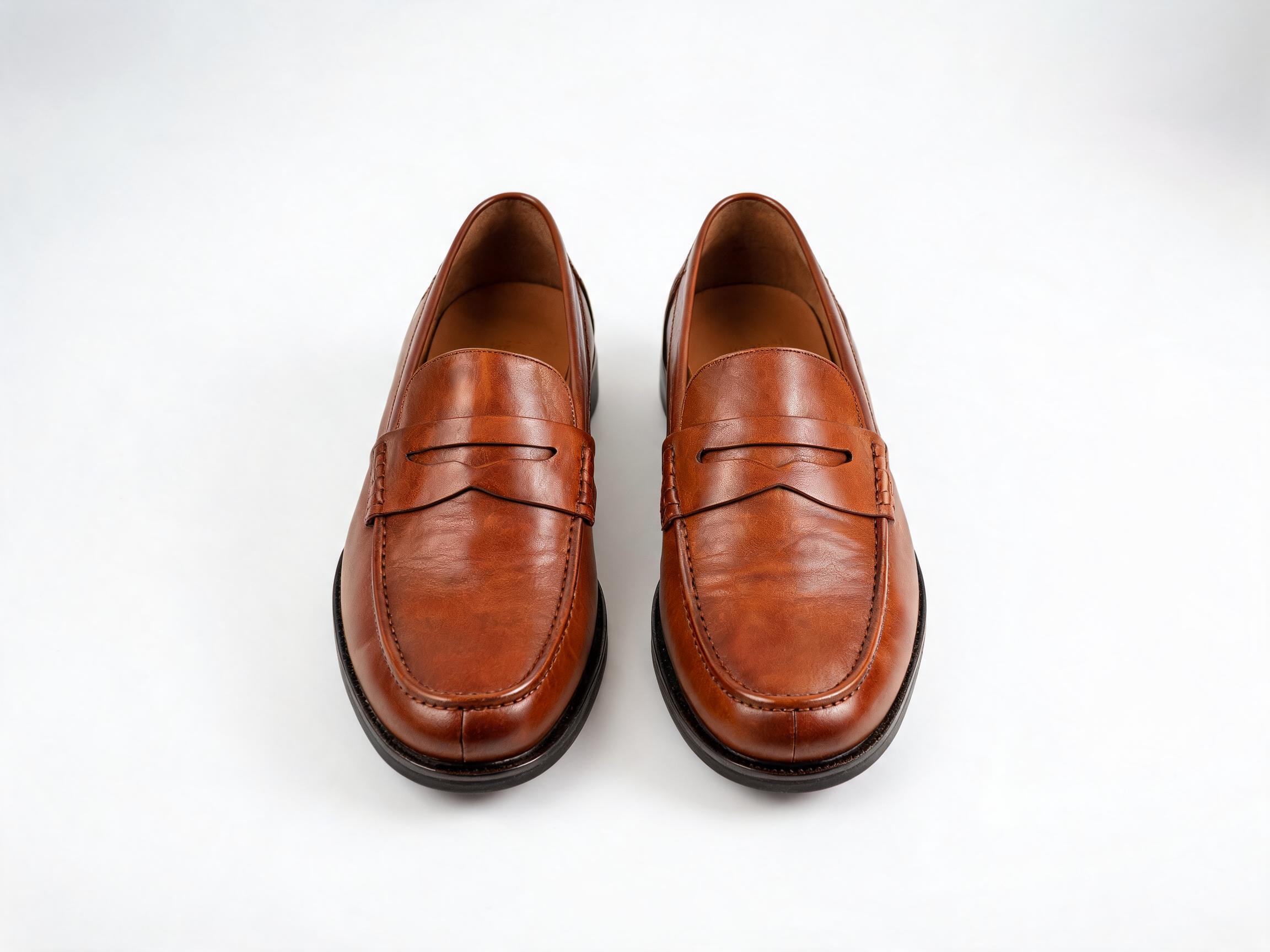
Its Cognac Penny Loafer Shoes illustrate the level of specification detail a buyer can use for verification: polished full-grain leather upper, hand-sewn penny strap, leather lining, cushioned insole, stitched rubber sole, heel height approximately 2.5 cm, and EU sizes 39–45. The listed MOQ is 100 pairs, with a lead time of 25–35 days—figures that should be confirmed with the sales team before ordering, as they may vary with material availability and order volume.
These disclosures are not proof of performance, but they provide concrete points to check during sample evaluation and factory discussions. A supplier that shares this level of detail is easier to screen than one that speaks only in general capabilities.
What to do next
Start with a shortlist of three to five wholesale shoe manufacturers. Send each the same set of screening questions from the checklist above, and request a production-run sample alongside a formal quotation. Compare the responses for specificity, consistency, and response time. The manufacturer that answers with verifiable details—and acknowledges the limits of its own figures—is the one most likely to execute your order without surprises.