
A practical playbook for B2B importers moving an OEM shoe program from first inquiry to production sign-off in China, covering what an RFQ must contain, how quotation and sampling are structured, and which checkpoints actually protect quality at each stage.
OEM Sourcing Playbook
A shoe program usually fails at the same places: an inquiry too thin to quote accurately, a sample approved for fit but not for production construction, or a pre-production meeting that never actually locks the details. The sourcing process itself is straightforward. What separates a smooth run from a costly one is knowing what each stage must produce before you move to the next.
This article maps the path from RFQ to production sign-off with an OEM shoes supplier in China, and flags the checkpoints that matter at each step. Aurevia Footwear Co., Ltd., based in Quanzhou since 2011, runs this process with in-house design and sampling for buyers in Europe, North America and the Middle East, so the sequence below reflects a working factory-side view.
What this playbook covers
- What an RFQ must contain
- From quotation to sample
- Fit approval and pre-production confirmation
- Mass production and final inspection
- Which checkpoints matter where
1. The RFQ: give the supplier enough to quote once
An RFQ that arrives as a photo and "how much per pair" produces a wide price guess, not a quotation. To get a quote you can build a margin on, the supplier needs to see the shoe as a defined product. Four packages should travel with the inquiry.
Technical package
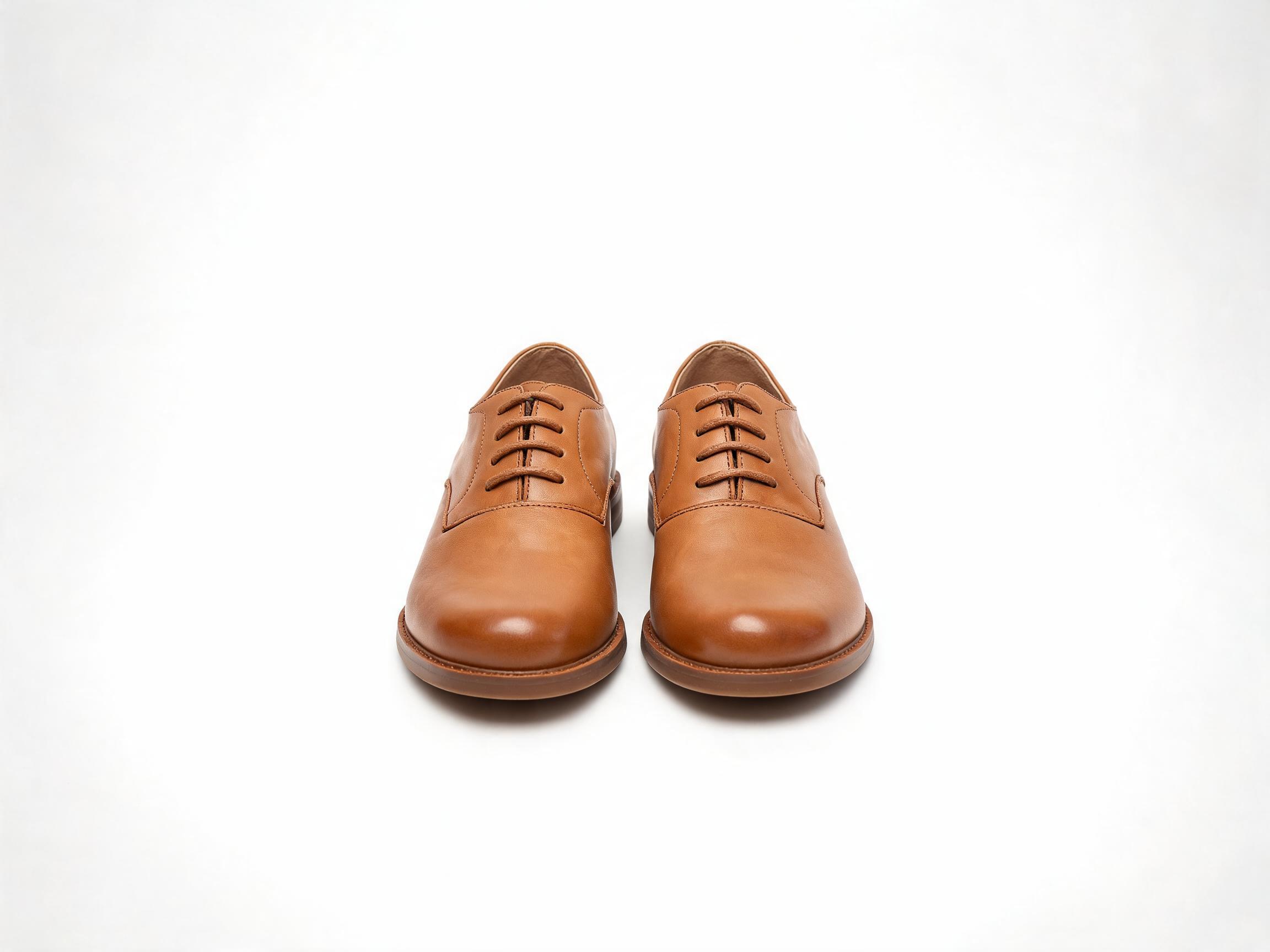
A tech pack is the anchor. For a closed-lacing style such as the tan leather Oxford shoes for women, that means the last shape or foot form, a technical sketch or CAD for each view, pattern callouts, heel height and the intended construction. Tan leather Oxfords sit at around a 3cm heel and run in EU sizes 35–41 — useful reference points when you describe your own pattern, though your specification overrides them.
If you have no tech pack yet, say so. A supplier with in-house sampling can help build one from references; what you must not skip is agreeing on the construction before pricing.
Materials and components
Name the upper material (genuine leather, or the specific synthetic you want), lining, insole and outsole, plus thread, lace and hardware. Leather sourcing should state grade, finished colour and finish type, because these drive cost and yield. Where you have a preferred tannery, name it; where you don't, ask what the supplier sources in-house.
Size range and fitting basis
Give the size run, the size system you want marked, and a reference last or a pair that fits your market well. Fit is the single most common reason a sample round repeats, and it is cheaper to settle the fitting basis in the RFQ than after the first sample.
Labelling and packaging
Specify logo placement and method, woven or printed labels, size tags, country-of-origin marking, inner box and carton specification, and any retail-ready requirement. Labelling errors are a leading cause of failed inspections, and the RFQ is the right time to spell them out.
RFQ checklist
- Tech pack with last, sketches, heel height and construction
- Full material and component list, including leather grade and finish
- Size range, size system and fitting reference
- Logo, label and packaging specification
- Target quantity per style and per colourway
- Destination market and any compliance requirements you must meet
- Requested sample quantity and any colour or material variants
2. Quotation: read what the price actually covers
A quotation should itemise, not just total. Ask for the per-pair price broken down by material, labour, packaging and tooling or pattern development where applicable. Confirm what is quoted: which size run, which material grade, what packing, and whether logo tooling or last development is included or billed separately.
Timing and minimum order quantities vary by style, material availability and pattern complexity, so neither is fixed across a catalogue. The supplier confirms both per style, and you should see them stated in the quotation rather than implied. When you compare suppliers, put the same RFQ in front of each so the prices describe the same shoe.
3. Sampling: the first real test of the brief
Sampling is where the RFQ becomes a physical object. Expect at least a development sample and, once fit and construction are agreed, a confirmation sample that represents what production will look like. The sample you approve is the reference the factory will match, so it must be built to the specification you intend to order — not a simplified version.
Inspect the sample against the tech pack, not against your impression of it. Check upper material and finish, stitching density and placement, symmetry across the pair, heel height, sole attachment, insole comfort and labelling. If the sample is a fit sample with substitute materials, mark it as such and keep it separate from the approval reference.
Three-stage quality control — incoming materials, in-line assembly and final inspection — is the structure that turns a good sample into consistent output. Ask at the quotation stage how a supplier sequences these stages; the answer tells you what happens between sample approval and the carton.
4. Fit approval: sign the pair, not just the drawing
Fit approval is a distinct decision from design approval. Design approval says the shoe looks right. Fit approval says it wears right on the agreed last in the agreed size range. Confirm the last number or form, the size grading, and the exact pair that represents the approved fit. Note any tolerance you accept — half a size of grading variation, for example — and record who approved it and when.
Keep the approved sample and the signed tech pack together. Every later dispute resolves faster when both parties can point to the same physical reference.
5. Pre-production confirmation: lock the details in writing
Before mass production starts, the order should be confirmed in a document that both sides sign. It should cover the approved sample reference, final material and colour approval, size and quantity breakdown, labelling and packaging, inspection standard and the confirmed timing for each milestone. This is also where you settle payment terms and the inspection arrangement.
Treat pre-production confirmation as the last cheap moment to change anything. A colour change after materials are cut, or a label revision after cartons are printed, costs far more than the same change made at this checkpoint.
6. Mass production: watch materials and in-line stages
During production, the checkpoints that matter are material verification against the approved specification, first-off approval on each size and colourway, and in-line review at cutting, stitching and assembly. Materials are checked on arrival against the approved standard; in-line checks catch drift before a whole run inherits it.
Ask for progress updates at agreed milestones rather than daily messages. If a material substitution becomes necessary, the decision should reach you before it reaches the line, not after the shoes are boxed.
7. Final inspection and sign-off
Final inspection closes the loop. The inspection should be conducted against the approved sample and the pre-production document, with results recorded per defect category rather than summarised as "passed." Labelling and packaging are inspected alongside the shoe, because a correct pair in a wrong carton still fails at the warehouse.
Sign-off is your formal acceptance. Review the inspection record, confirm the shipped quantity and packing, and keep a retained pair from the production run alongside the approved sample. That pair becomes your reference for the next order.
Which checkpoints matter at which stage
| Stage | What it should produce | Checkpoint that protects quality |
|---|---|---|
| RFQ | A complete brief: tech pack, materials, sizes, labelling | Supplier confirms the construction before quoting |
| Quotation | Itemised price, quantity and timing confirmed per style | Same RFQ compared across suppliers |
| Sample | A physical pair built to specification | Inspect against the tech pack, not impressions |
| Fit approval | Signed fit reference on the agreed last and grading | Approved sample retained with the signed pack |
| Pre-production | Signed order confirmation covering every detail | Final change window before materials are cut |
| Mass production | Consistent output across sizes and colours | Material verification and first-off approval |
| Final inspection | Recorded inspection against the approved reference | Retained production pair for the next order |
The pattern behind the process
Every strong checkpoint on this list is a written or physical reference both sides can point to: the tech pack, the quotation, the approved sample, the fit sign-off, the pre-production document, the inspection record. Programs that run smoothly are not the ones with the fastest factory; they are the ones where each stage closes before the next opens. Aurevia Footwear's OEM and ODM work in Quanzhou follows this sequence, with in-house design and sampling keeping the sample-to-production handoff inside one team.
If you have a style coming up, the most useful first step is a complete RFQ — send the tech pack, material list, size range and labelling spec, and ask for a quotation that states quantity and timing per style. A supplier who answers those points precisely is telling you something about how the production run will go.